
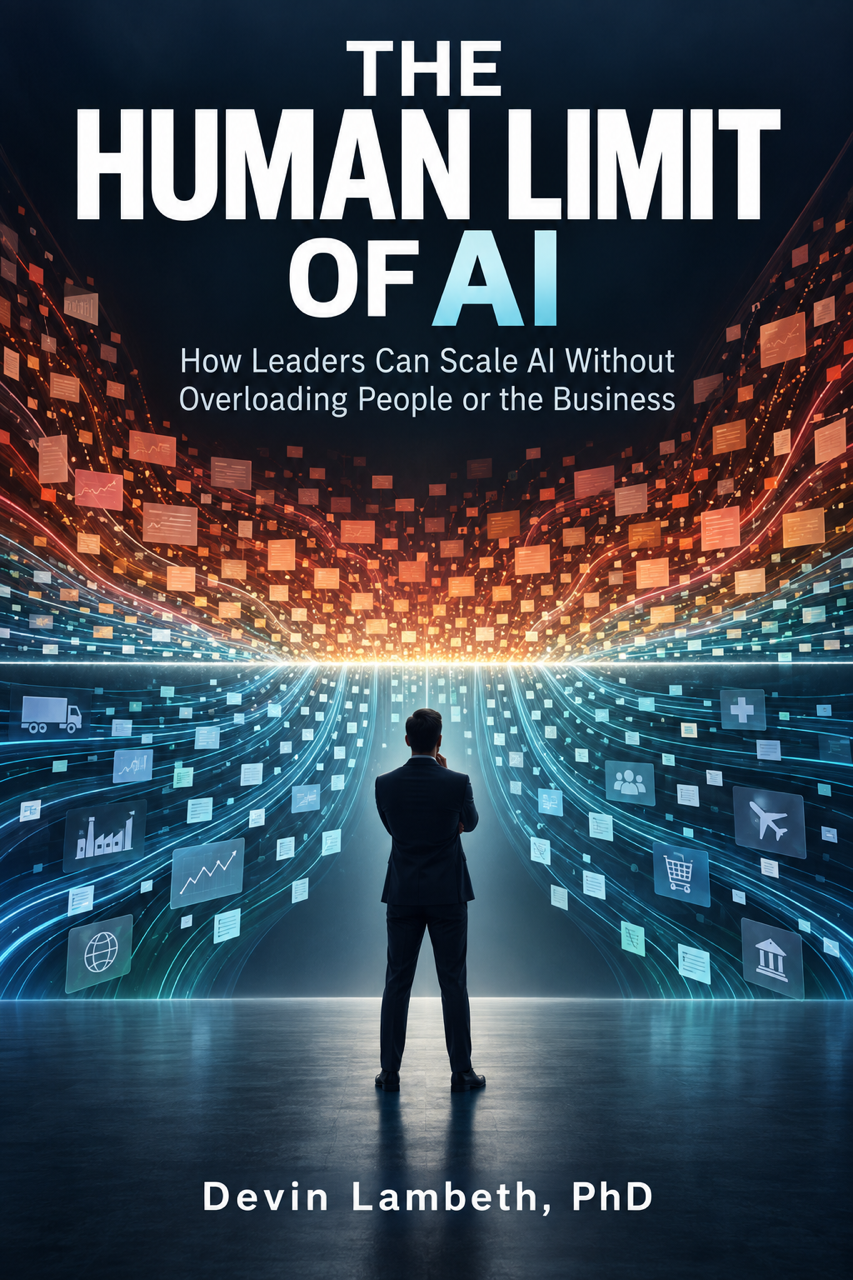
Description
Artificial intelligence promises to make organizations faster, smarter, and more efficient. But what happens when AI begins producing information, alerts, recommendations, and work faster than people—and the business itself—can effectively process them?
In The Human Limit of AI, Devin Lambeth, PhD, examines a critical challenge facing organizations adopting artificial intelligence: more AI does not always create more business value.
Drawing from research, operational experience, and real-world examples, Lambeth introduces the Lambeth AI Augmentation Capacity (LAAC) framework—a practical way for leaders to think about the relationship between AI-generated demand, human processing capacity, service capacity, and business performance.
Written for business owners, executives, managers, security professionals, and anyone responsible for implementing AI, this book moves beyond the question of what AI can do and asks the more important question: How much AI can your organization actually use effectively?
Readers will learn how to:
• Recognize when AI augmentation is improving performance—and when it is creating overload
• Identify the human and organizational bottlenecks that can undermine AI investments
• Understand the Business-Value Saturation Point, where additional automation may stop producing additional value
• Evaluate AI initiatives based on operational outcomes rather than technology alone
• Build a more deliberate, human-centered approach to AI strategy
• Take practical first steps toward introducing AI without overwhelming employees, customers, or existing operations
The goal is not to slow AI adoption. It is to make AI adoption sustainable.
The organizations that succeed with artificial intelligence will not necessarily be those that deploy the most AI. They will be the ones that understand where technology creates value, where human capacity becomes the constraint, and how to keep the two in balance.


Reviews
There are no reviews yet.