
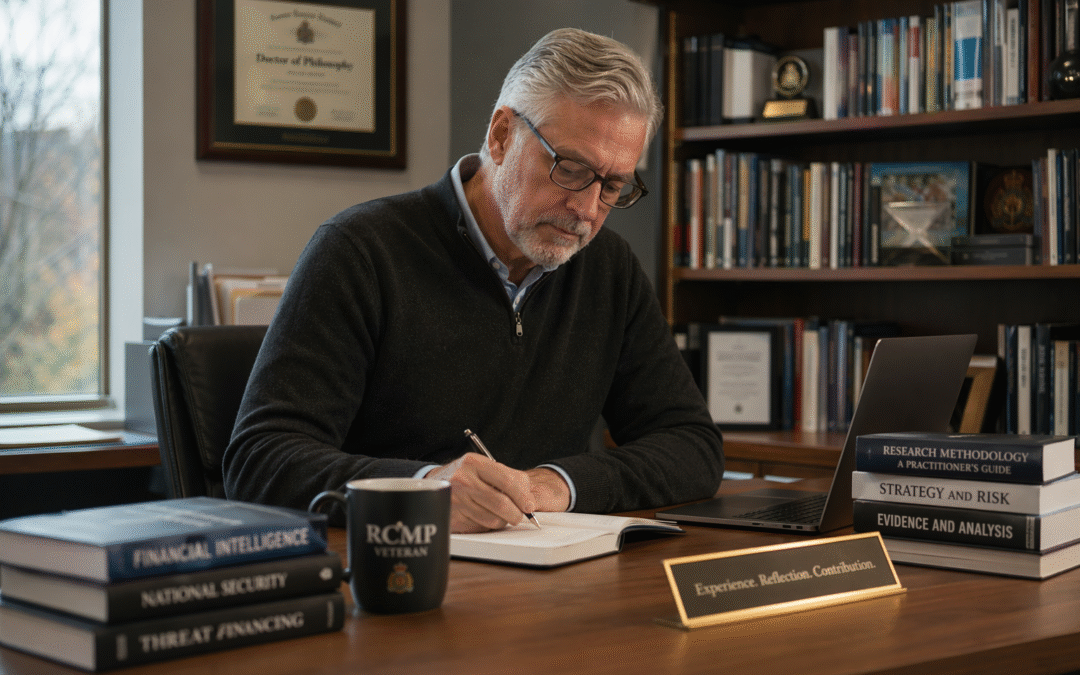
Undertaking a doctoral degree in one’s 60s is not a conventional decision. For many, this stage of life is not typically associated with such ventures. Yet for some practitioners, the desire to formally capture, structure, and interrogate a lifetime of professional experience remains compelling. That was the case for me. The pursuit of a PhD was not about career advancement. It was about intellectual closure, a way to translate decades of applied work into a coherent academic contribution.
In traditional academic narratives, the doctorate is often framed as an early or mid-career pursuit. It is positioned as a gateway credential, an entry point into academia, research, or specialized professional roles. Yet this framing overlooks a growing and important cohort: late-career professionals who undertake doctoral study not as a means of advancement, but as a form of intellectual consolidation.
For the experienced practitioner, a doctoral degree, particularly a practitioner-oriented PhD by Portfolio, can serve a different purpose. It is not about credential acquisition in the conventional sense. Rather, it is a capstone. It provides a structured mechanism to synthesize decades of applied experience, transform tacit knowledge into explicit frameworks, and subject that knowledge to critical scrutiny.
A portfolio-based doctorate requires candidates to curate a coherent body of work and demonstrate intellectual integration across varied outputs. Rather than a single thesis, it evidences sustained advanced thinking, decision-making, and problem-solving. In this respect, it reflects senior professional practice, where knowledge is dynamic, context-driven, and often interdisciplinary. Institutions such as the Swiss School of Business Research recognize this distinction and offer doctoral pathways aligned with practitioner expertise.
However, beyond its academic and professional value, the late-career doctorate carries an underappreciated benefit, its impact on cognitive health.
From a neurocognitive perspective, doctoral-level work constitutes intensive mental training. The process engages multiple domains simultaneously: memory retrieval, analytical reasoning, abstract thinking, and written articulation. It demands sustained attention over long periods, often amid ambiguity and intellectual uncertainty. These are precisely the conditions associated with neuroplasticity, the brain’s ability to reorganize and form new neural connections in response to challenge.
Research in cognitive aging consistently points to the protective effects of complex mental engagement. Activities that require learning, synthesis, and adaptation are associated with maintaining the brain’s resilience against age-related decline. In this context, a doctoral program is not merely an academic exercise; it is a structured, prolonged engagement with high-level cognitive demands.
Importantly, the value here is not contingent on institutional hierarchy or traditional academic pathways. Whether the doctorate is obtained through a conventional dissertation or a practitioner-oriented portfolio, the cognitive demands remain substantial. The brain does not differentiate between PhD degree frameworks. It responds to challenge, complexity, and sustained effort.
There is also a deeper, less tangible dimension. For many late-career professionals, the doctoral journey becomes an exercise in meaning-making. It provides an opportunity to step back from operational tempo. It allows one to reflect on the broader patterns, decisions, and impacts that have defined a career. This reflective process is itself cognitively and psychologically significant. It transforms experience into insight.
In this sense, the late-career doctorate occupies a unique space. It is simultaneously retrospective and forward-looking. It consolidates what has been learned while reinforcing the capacity to continue learning.
As professional lifespans extend and the concept of retirement evolves, there is value in rethinking how we approach intellectual engagement in later stages of life. The pursuit of a doctoral degree, particularly one grounded in practice, should not be viewed as anomalous. It should be recognized as an optimal form of continued development.
The doctorate, then, is not only a credential. It is a cognitive investment.
https://ssbr-edu.ch/phd-by-portfolio/
The Swiss School of Business Research reflects a deliberate recognition that advanced scholarship does not reside exclusively within traditional academic pathways. It can also emerge from practice, refined through experience and structured through reflection. It is validated through rigorous intellectual engagement.
For the late-career practitioner, that recognition matters. It affirms that a lifetime of professional work is not simply experience to be remembered, but knowledge to be examined, challenged, and ultimately, understood.
The Swiss School of Business Research has been instrumental in making this journey possible. The PhD by Portfolio provided not only a framework for formalizing a career’s worth of experience but also a deeply engaging intellectual process. This process enhanced both my understanding of my own work and my overall well-being. In that respect, the experience has been as personally meaningful as it has been academically rewarding.
Frequently Asked Questions (FAQs)
1. What is a PhD by Portfolio, and how does it differ from a traditional PhD?
A PhD by Portfolio is a doctoral pathway that allows candidates to submit a curated body of existing work, rather than producing a single, monolithic dissertation. The emphasis is on demonstrating intellectual coherence, critical reflection, and sustained contribution to knowledge across a professional career. While the format differs, the level of rigor, analysis, and academic scrutiny remains comparable to traditional doctoral programs.
2. Is a late-career doctorate a realistic option?
Yes. While less conventional, late-career doctoral study is increasingly recognized as a meaningful path for experienced professionals. It is particularly suited to individuals seeking to consolidate and formalize their expertise rather than pursue career advancement in the traditional sense.
3. What types of candidates are best suited for a practitioner-oriented doctorate?
This pathway is ideal for senior professionals with substantial experience, a documented body of work, and the ability to engage in critical reflection. Candidates typically bring interdisciplinary insights and are motivated by intellectual synthesis rather than credential acquisition alone.
4. How rigorous is a portfolio-based doctoral program?
Portfolio-based doctorates maintain high academic standards. Candidates must demonstrate critical thinking, theoretical integration, methodological awareness, and a clear contribution to knowledge. The work is assessed for coherence, originality, and intellectual depth, not simply experience.
5. Will this type of doctorate be recognized academically and professionally?
Recognition depends on the institution’s accreditation and reputation. Established institutions offering practitioner doctorates, such as the Swiss School of Business Research, design their programs to meet rigorous academic expectations while accommodating professional expertise.
6. How long does it typically take to complete a PhD by Portfolio?
The duration varies depending on the candidate’s existing body of work and pace of study. For experienced professionals, it can often be completed more efficiently than a traditional PhD, though it still requires significant time for reflection, integration, and writing.
7. What are the cognitive benefits of undertaking a doctorate later in life?
Doctoral study engages memory, reasoning, and analytical skills at a high level. Research suggests that sustained intellectual challenge can support neuroplasticity and cognitive resilience, making such endeavors beneficial beyond academic outcomes.
8. Is it necessary to be actively working in academia to pursue this degree?
No. Many candidates remain in professional roles or are transitioning into advisory, teaching, or mentoring positions. The degree is particularly relevant for those bridging practice and academic insight.
9. How does a late-career doctorate contribute to personal fulfillment?
For many, it serves as a form of intellectual closure and meaning-making. It allows professionals to step back, reflect on their career, and transform lived experience into structured knowledge and insight.
10. Why choose a school like the Swiss School of Business Research for this pathway?
Institutions like SSBR are designed to recognize and support practitioner expertise. They offer flexible, research-focused frameworks that respect professional experience while maintaining academic rigor, making them well-suited for non-traditional doctoral candidates.
Bio Dale Duchesne:
After more than three decades in policing, Dale has transitioned from frontline federal investigations to academia. His career with the Royal Canadian Mounted Police was centred on complex investigations into money laundering, terrorist financing, and national security threats. This work required a sustained focus on financial intelligence, inter-agency collaboration, and evidence-driven decision-making in high-stakes environments.
He now brings that operational experience into the classroom. As a part-time instructor at two polytechnic institutions, he teaches criminology, law, and courses focused on money laundering and terrorist financing. His teaching emphasizes the practical application of financial intelligence within the investigative process, bridging theory and practice for students preparing to enter the field.
This transition reflects a continued commitment to public service, now through education, mentorship, and the development of future practitioners equipped to navigate the evolving landscape of financial crime and national security.
